Isnin, 16 Mei 2011

ANTENNA PARABOLA.

Antena parabola

Dari Wikipedia bahasa Indonesia, ensiklopedia bebas
Antena parabola adalah sebuah antena berdaya jangkau tinggi yang digunakan untuk komunikasi radio, televisi dan data dan juga untuk radiolocation (RADAR), pada bagian UHF and SHF dari spektrum gelombang elektromagnetik. Panjang gelombang energi (radio) elektromagnetik yang relatif pendek pada frekuensi-frekuensi ini menyebabkan ukuran yang digunakan untuk antena parabola masih dalam ukuran yang masuk akal dalam rangka tingginya unjuk kerja respons yang diinginkan baik untuk menerima atau pun memancarkan sinyal. Antena parabola berbentuk seperti piringan. Antena parabola dapat digunakan untuk mentransmisikan berbagai data, seperti sinyal telepon, sinyal radio dan sinyal televisi, serta beragam data lain yang dapat ditransmisikan melalui gelombang. Fungsi antena parabola yang umum diketahui oleh masyarakat di Indonesia adalah sebagai alat untuk menerima siaran televisi satelit.

Daftar isi

[sembunyikan]

[sunting] Sejarah antena parabola

Sejarah antena parabola dapat diamati mulai dari tahun 1970an. [1] Ketika itu belum ada penyedia/provider untuk televisi satelit. Televisi satelit mulai tumbuh tahun 1976. HBO adalah stasiun televisi pertama yang mengembangkan program-program televisi kepada perusahaan kabel melalui transmisi satelit televisi. Antena parabola C-band ditemukan oleh seorang profesor di Stanford yang mencoba membangun antena parabolanya sendiri dan berhasil menangkap siaran HBO.
Pada masa itu antena parabola C-band berukuran sangat besar. Karena itu, antena parabola diletakkan di halaman. Ketika itu, tidak ada ruang yang cukup untuk meletakkan antena parabola. Harga antena parabola pada masa itu mahal. Pada tahun 1980an, berbagai perusahan mengembangkan antena parabola C-band. Karena itu, harga antena parabola turun. Akibatnya, banyak program yang dirancang untuk televisi satelit dan dianggap sebagai investasi. Pada tahun 1984, Kongres Amerika mengesahkan Cable Act. Ini dari Cable Act adalah untuk memperbolehkan berbagai perusahaan kabel melakukan enkripsi pada siaran mereka. Hal ini dilakukan karena ada penonton yang tidak membayar untuk layanan televisi satelit. Enkripsi berhasil mengarahkan orang-orang untuk berlangganan televisi kabel.
Pada tahun 1990an, enkripsi yang digunakan berhasil diretas. Akibat dari peretasan tersebut, perusahaan-perusahaan mulai mengembangkan dan menggunakan transmisi digital. Antena parabola berperan besar dalam perkembangan industri layanan televisi satelit. Dish Network, sebuah perusahaan penyedia layanan televisi satelit memulai penyiaran mereka pada tahun 1996. Mereka memanfaatkan antena parabola. Pada tahun yang sama, DirecTV juga mulai bersiaran. Akibatnya, terjadi persaingan antarpenyedia layanan televisi satelit dan menandai persaingan antara berbagai perusahaan penyedia layanan televisi satelit. Saat ini Dish Network Company telah tumbuh dan menawarkan berbagai program televisi digital dan HDTV. Dish Network menyediakan berbagai saluran dan program dalam definisi tinggi. Dish Network juga menjadi penyedia layanan televisi antena parabola dengan pelanggan yang banyak.
Pada tahun 1970, 1980, dan 1990an antena parabola mengubah cara kerja pemrograman televisi. Perubahan tersebut ditandai dengan perubahan pada peralatan televisinya. Pada masa itu, antena parabola jenis C-band yang besar telah hilang. Antena parabola jenis C-band telah berubah ukuran menjadi lebih kecil. Kini, antena parabola berukuran kecil. Antena parabola mampu diletakkan di atap dan tidak mengganggu stabilitas bangunan. Ukurannya tidak lagi mengganggu pemandangan. Berbagai saluran dan program-program televisi yang menggunakan antena parabola telah mampu ditransmisikan dengan jelas dan tanpa gangguan. Saat digunakan menonton HDTV, antena parabola mampu mentransmisikan gambar yang realistis.

[sunting] Prinsip kerja

Bentuk antena yang seperti piring memantulkan sinyal ke titik fokus piringan tersebut. Di titik fokus tersebut ditempatkan sebuah alat yang disebut feedhorn. Alat ini menjadi titik pusat untuk pemandu gelombang yang mengumpulkan sinyal di atau dekat di titik fokus dan mengubahnya menjadi low-noise block downconverter (LNB). LNB mengubah sinyal dari gelombang elektromagnetik atau gelombang radio menjadi sinyal listrik dan menggeser rentangnya dari C-band atau Ku-band menjadi L-band. Antena parabola untuk penyiaran langsung menggunakan LNFB, yang mengintegrasikan feedhorn dengan LNB. [2]
Theoretical gain dari sebuah antena parabola meningkat seiring dengan meningkatnya frekuensi. Gain yang sebenarnya bergantung dari banyak faktor, diantaranya hasil akhir permukaan parabola, akurasi bentuk, dan kesesuaian feedhorn. Nilai umum bagi konsumen yang memiliki antena parabola 60cm 11.75 GHz adalah 37.50 dB.
Dengan menggunakan frekuensi lebih rendah seperti C-band, pembuat antena parabola memiliki pilihan lebih luas untuk bahan pembuatannya. Ukuran antena parabola besar yang dibutuhkan untuk frekuensi lebih rendah mendorong antena parabola untuk dikonstruksi dari lempengan logam dan kerangka logam. Pada frekuensi lebih tinggi desain tipe lempengan lebih sedikit meskipun beberapa desain menggunakan piringan padat.
Miskonsepsi yang umum terjadi adalah LNBF, alat di depan piringan, menerima sinyal langsung dari atmosfer. Sebagai contoh, hitung mundur BBC News menunjukkan “arus data merah” diterima langsung oleh LNBF daripada diterima oleh piringannya lebih dulu. Seharusnya bentuk parabola akan mengumpulkan sinyal ke wilayah yang lebih kecil dan mengirimkannya ke LNBF. [3]
Piringan modern yang ditujukan untuk digunakan pada televisi rumahan umumnya berdiameter 43-80 cm. Antena parabola tersebut tidak bisa dipindah-pindahkan/fixed position. Ini berlaku untuk antena parabola untuk menerima sinyal Ku-band. Sehubungan dengan adanya layanan direct broadcast satellite, antena-antena parabola untuk keperluan rumah biasanya memiliki parabola C-Band yang memiliki motor. Diameter parabola ini sebesar 3 meter. Tujuan adanya motor adalah untuk menerima saluran-saluran dari satelit penyiaran yang berbeda. Piringan yang terlampau kecil untuk antena parabola masih memiliki gangguan, seperti gangguan sinyal akibat hujan dan gangguan dari satelit-satelit lain.

[sunting] Desain sistem

Untuk instalasi receiver di rumah, sebuah kabel digunakan untuk menghubungkan receiver dengan LNB. Receiver tersebut menggunakan penyedia daya berbeda (14/18V) untuk memilih polarisasi dan pilot tones (22kHz) untuk menginstruksikan kepada LNB agar memilih satu dari dua gelombang frekuensi yang ada. Untuk instalasi yang lebih besar, setiap gelombang dan polarisasi diberikan kabel masing-masing. Maka, akan ada empat kabel dari LNB ke switching matrix. Switching matrix memungkinkan koneksi dari beberapa receiver berbeda dalam sebuah topologi bintang (star topology) yang menggunakan metode signalisasi signalling yang sama dalam sebuah instalasi receiver.

[sunting] Tipe-tipe parabola

[sunting] Piringan dengan motor

Sebuah piringan yang ditegakkan di sebuah tiang dan digerakkan dengan motor atau servo dapat dikendalikan dan diputar atau dirotasikan untuk menghadap berbagai posisi satelit yang berada di angkasa. Piringan-piringan antena parabola yang dapat digerakkan sangat digemari. Antena parabola dengan motor yang bisa digerakkan memiliki tiga standar berbeda, yaitu DiSEqC, USALS, dan 36v positioners. Banyak receiver yang dapat mendukung ketiga standar di atas.

[sunting] Multisatelit

Multisatelit adalah piringan yang dapat menampung sebanyak 16 buah posisi satelit (Ku-band). Beberapa desain memungkinkan beberapa penerimaan sekaligus dari beberapa posisi satelit berbeda tanpa harus mengubah posisi piringan. Sumbu/axis vertikal bekerja sebagai sebuah reflektor Cassegrain off-axis concave parabolic concave hyperbolic. Sumbu/axis horizontal bekerja sebagai concave convex Cassegrain. Titik dari piringan utama bergerak ke piringan sekunder, yang memperbaiki astigmatisme melalui bentuk bengkok/curvature yang bervariasi. Celah yang berbentuk elips yang dimiliki piringan primer didesain untuk menyesuaikan diri dengan iluminasi yang diperkecil oleh horn antena parabola. Karena tumpahan ganda/double spill-over, maka penggunaan piringan besar akan lebih masuk akal.

[sunting] VSAT

VSAT adalah tipe antena parabola yang paling populer. VSAT adalah singkatan dari very small aperture terminal. Antena parabola jenis VSAT menyediakan komunikasi internet satelit dua arah dan jaringan pribadi untuk berbagai organisasi. Saat ini, sebagian besar VSAT beroperasi di gelombang Ku-band. Hal itu terjadi karena gelombang C-band terbatas hanya untuk beberapa wilayah di dunia. Ada pergerakan yang dilakukan mulai tahun 2005 untuk mendorong adanya satelit Ka-band yang beroperasi di frekuensi lebih tinggi. Jenis satelit tersebut menawarkan kerja yang lebih baik dengan biaya yang lebih rendah. Ukuran antena-antena tersebut bervariasi, dimulai dari antena yang berdiameter 74 hingga 120cm. Untuk kebanyakan aplikasi, antena parabola VSAT dengan C-band sebesar 4 meter.

[sunting] model lain

Ada beberapa jenis antena parabola lain yang digunakan, di antaranya:
  • Antena parabola individual, yaitu antena parabola yang hanya digunakan untuk satu tempat tinggal. Contohnya Direct to Home (DTH).
  • Antena parabola kolektif, yaitu antena parabola yang penggunaannya dibagi ke beberapa tempat tinggal. Contohnya satellite master antenna television (SMAT) dan communal antenna broadcast distribution (CABD).
  • Automatic-tracking satellite dish (ATSD). Antena parabola jenis ini adalah antena yang dapat digunakan ketika ditempatkan di sebuah kendaraan yang bergerak, seperti mobil. Ketika kendaraan bergerak, antena parabola akan bergerak mencari gelombang yang dibutuhkan. Proses ini dinamakan automatic tracking. Antena parabola yang menggunakan automatic tracking menggunakan giroskop, sensor GPS, data identifikasi tersendiri untuk satelit, serta dekoder DVB untuk membantu identifikasi satelit yang sedang diarahkan.
  • BUD atau big ugly dish adalah antena parabola gelombang C-band. Antena parabola ini adalah antena parabola TVRO yang digunakan untuk menerima sinyal satelit televisi dari satelit tipe FCC dalam gelombang mikro C-band. Diameter big ugly dish sekitar 3.5 meter.

[sunting] Antena parabola untuk televisi satelit

Antena parabola biasanya ditempatkan di atap-atap rumah. Kini, pemilik antena parabola tidak hanya ada di kota-kota besar saja, tapi juga telah ada di daerah pedesaan. Untuk penyiaran televisi satelit, antena parabola mampu menyiarkan beragam acara, di antaranya adalah film, acara olahraga, dan berita. Kualitas gambar dari antena parabola berbeda dengan antena biasa yang ditemukan di berbagai rumah. Kualitas gambar dari antena parabola lebih bagus dan kualitas suara yang diperdengarkan juga lebih baik.

[sunting] Kelebihan dan kelemahan

Menggunakan antena parabola dan koneksi satelit memiliki kelebihan dan kekurangannya sendiri-sendiri. [4]
Kelebihan menggunakan antena parabola dan koneksi satelit adalah kualitas video dan kualitas audio yang lebih baik jika digunakan untuk menerima siaran dari televisi satelit. Bentuk antena parabola seperti piringan membuat transmisi lebih mudah diterima, sangat cocok untuk menangkap gelombang di tempat-tempat yang jauh dari pusat transmisi. Untuk televisi satelit, antena parabola sangat memudahkan untuk menangkap siaran, bahkan di tempat-tempat yang jauh dibandingkan menggunakan antena televisi biasa.
Kelemahan yang paling memengaruhi antena parabla dan layanan satelit adalah harga yang mahal untuk peralatan yang dibutuhkan. Antena parabola juga tidak bisa langsung membagi saluran jika di dalam satu rumah memiliki dua atau lebih perangkat televisi. Semua televisi di suatu rumah akan menyiarkan program yang sama, karena tidak ada pembagian transmisi. Untuk melakukannya, dibutuhkan peralatan tambahan seperti tuner digital yang dapat membagi transmisi agar televisi berbeda di satu rumah mampu mengakses program yang berbeda. Kelemahan yang juga harus diperhatikan adalah gangguan cuaca. Antena parabola dapat mengalami gangguan dalam menerima transmisi jika cuaca terlalu buruk.


ANDA SEBAGAI RAKYAT HARUS MENGHORMATI RAJA.

Saya sebagai rakyat malaysia yang berketurunan thai ingin memberi panduan kepada anda satu malaysia harus menghormati raja.Bagi saya kita sebagai rakyat harus menghormati raja.Di sebabkan raja adalah salah satu sistem beraja.Walaupun adaik beradik raja thai saya tetap mentaati setia kepada maharaja saya.saya juga boleh menyanyi lagu kebangsaan thai dan juga lagu maharaja thai walaupun saya rakyat thai malaysia.Kita sepatut menghormati raja.Dia adalah ketua agama rasmi.Daulat Tuanku Somprak chairak.

HM KING BHUMIBOL ADULYADEJ


Back to the Royalty Index
King Rama IX

King Bhumibol Adulyadej (Rama IX) was born in Cambridge, Massachusetts, United States of America, on 5 December 1927, youngest son of Their Royal Highnesses Prince Mahidol of Songkla and the Princess Sri Nagarindra, the Princess Mother (formerly Miss Sangwal Talapat), and is the direct grandson of His Majesty King Chulalongkorn (Rama V) and Queen Savang.  His Majesty the King had one older sister, Her Royal Highness Princess Galayani Vadhana of Naradhivas, and one older brother, His Majesty King Ananda Mahidol (Rama VIII).  His Majesty became King of the Kingdom on Thailand on 9 June 1946.  The Coronation Ceremony came later on 5 May 1950. His Majesty continued his education in Switzerland, and returned to Thailand in 1951. While in Switzerland, he met the aristocratic Mom Rajawongse Sirikit Kitiyakara, who has since become HM Queen Sirikit.
During that time, Siam had become Thailand, and was still unstable since the change from Absolute Monarchy to Constitutional Monarchy in 1932. The people of Thailand was still in need of a King who can guide the country into prosperity. The Thai Kingship was, and still is, seen as a strong pillar for the Thai people to hold on to, while there is still uncertainty in the political arena, even to this day. More than 60 years on, many can still remember His Majesty's Oath of Succession to the Throne :
King & his people
"We will reign with righteousness for the benefit and happiness of the Siamese people."

And what the King has said, he has done, and continues to do.
.
King & his people
His Majesty the King has been the guiding light during his more than 60 years as King of Thailand, making him currently the longest reigning monarch in the world. He has seen 26 Prime Ministers come and go, and is currently with the 27th Prime Minister of Thailand. These two dozens or so prime ministers represented different political parties, different thinking, different view points, so it can be said that His Majesty has seen them all, as he went through so many changes, disruptions, political turmoils and more. As a constitutional monarch, he is above politics. His main focus has thus been trying to better the livelihood of the Thai people, especially in the rural area, and far-reaching corners of the kingdom. He has also played the perfect diplomat between two warring sides of the different governments and political opponents during the many political upheavals in the recent Thai history. With all the political turmoils, the King has stood by the Thai people, and act as a strong pillar of righteousness and guiding light for the people to hold on to.
King & his people
Constitutional Monarchy
A constitutional monarch is above politics. He lives under the law of the kingdom, but cannot be involved in politics. In fact, all royals with the ranks of Mom Chao (Serene Highnesses) up cannot be involved in politics, nor have any voting rights, including not being able to join political parties nor become politicians. In addition, the royals should not show their slant towards any particular political parties.
His Majesty King Bhumibol has acted righteously in all of the political events of Thailand from past to present. He has only become involved during extreme situations involving bloodshed, and then only as a mediator between two or more factions, trying to get to a solution of calm and peace. Lately, many has forgotten the role of the King, and tried to drag his good name into the political mess. The King continues to stand tall, and has not involved himself. He neither denies nor accepts any misconceptions thrown out at him, as the modern Thai people continues to show their ignorance in not knowing what a constitutional king can or cannot do. Even political individuals have also forgotten this, and tries to drag the King’s good name to their sides, only with the sole intention of trying to win over the voice of the people. Many descendants of the different royal houses (rankings of Mom Rajawongse down) have also become involved in the different sides, and have since drag the King’s name with them as well. They are in fact not counted as royals, but as citizens of the kingdom, who are descendants of royalty, but now have rights to vote and make known their political views. Even they have forgotten the role of a constitutional monarch, as well as how their fathers (Mom Chaos), as royals, were expected to act in the good name of the Thai Royal Family.
More than Words
More than words can express one's feeling towards King Bhumibol Aduyadej
King & his people
The King and His People
His Majesty King Bhumibol Adulyadej is undoubtedly his people’s King; the Father of the Land. When he moved back to Thailand for good in 1951, he began his visits to his people almost straight away. He is the first Thai King, and Thai individual, to see every single corners of his kingdom. He has visited far-reaching places. Where there were no roads, he used helicopters; where there were no place for helicopters to land, he went by jeeps, horses, as well as on foot. It is said that he is the only individual in Thailand, past and present, and most probably the future, to see every single square inch of his land. With his visits, he brought medical teams as well as surveyors to plan the connection of all towns and villages, a route to prosperity. He helped with irrigation problems as the majority of the Thai people were farmers, depending solely on their crops for their income. He has also eradicated the opium growing culture of many hilltribes of the north, and proposed substitutions with valuable crops. During the time of natural crisis, the King has always been the first person to be on the scene. Only until recently that the King has not been able to travel to the affected places due to health problems, nevertheless, his team has continued to visit and help out according to the King’s instructions. In addition, he has continued to contribute personal funds quick and fast to the needy, as seen most recently with the flooding disaster around the Kingdom in late 2010, when the King’s team was the first to act the fastest, while government team became the slowest, especially with all the bureaucracies they had to go through before help could be dispatch to the flooding victims. With the continual disputes within the political world, the Thai people are becoming more and more dependent on the King to guide them through everyday lives; a source of simple strength needed to lead a happy life in this ancient Kingdom.
King & his people

King & his people

King & his people
The Thai Concept of Kingship
A King is the Father of the Land. It’s quite a simple concept, really. A father is expected to look after his children and give them the basic needs to live on, and provide good basic education for them, as foundation to make a living when they are grown up. The good children will then look after their father in old age, so that he will have a comfortable life after he retires.
His older and wiser children were to form a group that would continue their father’s work, to better the lives of the younger children and bring peace and prosperity to the family and their home. The King, though, is father to over 60 million children, and growing. He has looked after his millions of children quite well, as witnessed by his actions through his visits, his projects, and his personal funds, all for the betterment of his country. I have to say that he has been the hardest working monarch in the world, as his subjects were not as healthy as others, nor were living in good conditions. But, the Thai people were happy back then, as they had simpler lives, and had the very basic needs. The ones that were quite lost, and lived away from developed areas were looked after by the King, and they were then slowly but surely connected to the civilization that make up the Kingdom. He has tried to improve education by setting up schools in rural, unreachable areas, and provided funds for their continuations. It is so much a single person can do for the 60 million subjects. It could have been quite easy for the government, the supposedly wiser and mature children, to continue these projects, as the basic foundation have been laid. With sound education, the Thai subjects could have moved to a better life working in jobs that were provided by the government and the private sector. The subjects would have been happy, with better lives, and no quarrels in politics. The subjects, in turn, will come to look after their King as a child to a father. Unfortunately, the King does not get to retire. And, it seems no one is looking after him when he has entered old age.
A Father is also expected to be the pillar of strength for his children. Indeed, the King has certainly been a very strong pillar. With the cumbersome bickering between political parties, unending it seems, since Thailand changed from absolute monarchy to a constitutional one, with what is called the system of democracy introduced to the land. This constance bickering has not benefited the country much, though Bangkok has seen huge developments in terms of infrastructures and much else, the rural areas are still in need of catching up, where some far-reaching areas are still without electricity. So, the King travelled again and again, and tried to bring developments to these areas. Personal funds can never be enough without the government’s additional monetary help. So, with the King going it alone, the underdeveloped parts will be slow to see their light-of-day.

King and Queen
The Thai people, especially the rural Thais, need someone who really cares just to be there as a comfort among chaos. The King has been just that. Photos of the King and Queen adorn the walls of most homes in Thailand, for that reason. When they feel bad, they look up to the King’s photo for comforting thoughts. When they are happy, they look up to the King’s photo to thank him for having been their King.
   
  The Royal Family of Thailand
Queen Sirikit
Her Majesty the Queen of Thailand Her Majesty Queen Sirikit was born Mom Rajawongse Sirikit Kitiyakara on 12 August 1932, daughter of His Serene Highness Prince Nakkhatra Mongkol of Chandaburi and Mom Luang Bua Kitiyakara.

The Royal marriage between Their Majesties the King and Queen took place on 28 April 1950 and Her Majesty was conferred the title of Somdetch Phra Nang Chao Sirikit Phra Baromma Rajini, official title of the Queens of Thailand.  In part of 1956, Her Majesty became Region of the Kingdom while His Majesty went into the monkhood, for which She was conferred the title of Somdetch Phra Nang Chao Sirikit Phra Baromma Rajini Nath, or Sirikit the Region Queen.

The Queen is completely devoted to His Majesty the King.  She oversees many of the King's projects as well as introducing her own programmes to benefit the Thai people especially in the rural areas through her SUPPORT Foundation.   The promotion of Thai silk by Her Majesty was a particularly important one, and has since become famous throughout the world. 

The year 2004 saw Her Majesty turning 72 - or 6th cycle birthday, which in Thailand is very auspicious. The Thai people jointly celebrated with activities throughout the year.
Crown Prince of Thailand
His Royal Highness Crown Prince Maha Vajiralongkorn HRH the Crown Prince of Thailand was born on 28 July 1952, the only son of the King and Queen.  His Royal Highness was invested the title of Crown Prince of the Kingdom of Thailand on 28 December 1972.  He received his education at Kings Mead and Millfield Schools in Great Britain, and at the King's School and the Royal Military College at Duntroon, Australia.  He also received the Degree of Bachelor of Laws from Sukhothai Thammatirat University, Thailand.
Since he was young, he was inclined towards the life in the military, and has since shown himself to be a great Military Man.  After his father, he has immersed himself in activities in promotion of the general welfare and economic betterment of his people as well as activities in promotion of public health through the Crown Prince Hospital and the Maha Vajiralongkorn Foundation.  He has also represented his father on numerous State Visits abroad, far too many to list in just a page.  The Crown Prince is a much loved figure in Thailand, and will continue to be so for many years to come.
The Crown Prince has been married to HRH Princess Sri Rasmi , The Royal Consort, since 10 February 2004. The Crown Prince has 2 daughters and 5 sons, namely:
HRH Princess Bajra Kitiyabha (7 December 1978)
HSH Mom Chao (Prince) Chudhavajra (29 August 1979)
HSH Mom Chao (Prince) Vajaresra (27 May 1981)
HSH Mom Chao (Prince) Chakrivajra (26 February 1983)
HSH Mom Chao (Prince) Vajravira (14 June 1985)
HRH Princess Siriwanwaree Nareeratana (8 January 1987)
HRH Prince Teepangkara Rasmichoti (29 April 2005)
Princess Maha Chakri Sirindhorn
Her Royal Highness Princess Maha Chakri Sirindhorn HRH Princess Maha Chakri Sirindhorn was born Princess Sirindhorn Debaratanasuda on 2 April 1955, the third child of Their Majesties the King and Queen.  She was created the Princess Maha Chakri Sirindhorn on 5 December 1977 (a royal rank equal to that of a crown prince, but is not a crown princess) for her tireless work in all sectors for the people.  She follows her father's every footstep, and is a most beloved princess of the kingdom.  Her work is far too numerous to list here - a new website will need to be created just to list everything.  She has set up many foundations, all for the betterment of the rural areas, notably the Sai Jai Thai Foundation.
For a closer look of the Princess, please visit her website
   The Golden Jubilee Network
Princess Chulabhorn
Her Royal Highness Princess Chulabhorn HRH Princess Chulabhorn is the youngest daughter of Their Majesties the King and Queen, born on 4 July 1957.  She achieved a Bachelor of Science in Organic Chemistry from Kasetsart University, Bangkok, and a Ph.D. in Organic Chemistry from Mahidol University, Bangkok.  Her numerous positions include Professor of Organic Chemistry at Mahidol University, President of the Chulabhorn Foundation, Chairman of the Working Group on the Chemistry of Natural Products, and Chairman of the Foundation for Promotion Nature Conservation and Environmental Protection.
The princess has two daughters,
HRH Princess Siribha Chudhabhorn (8 October 1982)
HRH Princess Adityadorn Kitigun (6 May 1984)
Toonkramom Ying Ubolratana Rajakanya Toonkramom Ying Ubolratana was born HRH Princess Ubolratana Rajakanya on 5 April 1951, eldest child of Their Majesties the King and Queen.  After finishing her education in the United States of America, she relinquished her royal title to marry an American commoner.  She has lived most of her life in the United States with her then husband, Peter Jensen, and their three children,
Miss Ploypailin Jensen (13 February 1981)
Mr. Bhumi (Poom) Jensen (1983-2004)
Miss Sirikitiya Jensen (19 March 1985)
After her divorce, the princess has moved back to Thailand, and has embarked on many activities for the betterment of the Thai people. One notable project is the "To Be Number One" project which deals directly with the drug problems in the kingdom.
In December 2004, the Princess visited Phuket for an official function and a private holiday with her family, and witnessed first hand the Tsunami that devastated the South of Thailand. In the event, she lost her son, Khun Poom, to the waves. She has since set up the Khun Poom Foundation to help autistic children in Thailand.

Related Links

A Commemorative Page in Celebration of the Diamond Jubilee 2006
For a comprehensive history of the King, please visit the official site of HRH Princess Maha Chakri Sirindhorn - The Golden Jubilee Network
For a more complete look at the King and his art, please visit "Supreme Artist," the new art museum-on-the-net entirely devoted to HM the King
   
   
  Back to Siamese Royalty . Back to Siamese Collection
   

THAILAND HISTORY SIAM AYUTTHAYA,SUKTHOTHAI.

hailand's History


Prehistoric Time

There has been humans in the South-East Asia region for tens of thousands years. Early, they got their food from hunting and fishing and later on they also became farmers and started to grow rice more than 5000 years ago. Also, one of the first bronze age cultures in the world, was found here.


The Dvaravati and Mon period

Theravada Buddhist missionaries came from India to the region in the 2nd century and the Mon and Dvaravati period was a loose collection of Indian city states. It was flourishing until about the 9th century but lasted in a few areas until the 11th or 12th century.


The Khmer Period

From about the 8th century the Khmer's' started to expand their territory around the capital of Angkor into Thailand, Laos, Vietnam and South China and finally they dominated the region. Lopburi became the Khmer's head quarter in present Thailand. The influence of Khmer and language, culture, architecture and art was also effecting the whole region at this time. In the 13th century the Khmer domination was weakened from various reasons, such as; bad economy, mutual conflicts and malaria, plague and other diseases.


The Sukhothai Period

The Thais became the largest population in the area after the decline of the Khmer empire. Even if Thai states, such as Lanna, existed in the North, Sukhothai is often considered as the first Thai kingdom. The Sukhothai kingdom was founded in 1238 and Intradit became the first king. Forty years later, Ramkhamhaeng became the third king in this era, and he is often considered as one of the most important figures in the Thai history. The Theravada Buddhism became the state religion and Ramkhamheang was the inventor of the Thai written language. The Sukhothai culture was still flourishing and expanded it's territory. It lasted until 1378.


The Ayutthaya Period

A new powerful kingdom Ayutthaya, in the South, was founded in 1350/51 by U Thong or king Ramathibodi as his name was after he ascended the throne. Ayutthaya expand it's territory and Sukhothai became a vassal state of Ayutthaya in 1378. Ayutthaya became a powerful and rich kingdom and King Ramathibodi and his successors expanded Ayutthaya's territory. Also Angkor was attacked and in 1550 it had about same borders as present Thailand. But in 1568/69 Ayutthaya fell to the Burmese. The kingdom was however re conquered by King Naresuan after killing the Burmese crown prince with his lance, in a duel on elephant backs. In the coming 100 years, Ayutthaya started to established trade agreements and diplomatic relations with some of their neighbors and the leading European states at this time. The most "cosmopolitan" regent, at the Ayutthaya era, was King Narai. The Frenchmen tried to convert Narai to Christianity but when Narai died, in 1688, the French were driven out, and the king's Greek advisor, Constantine Phaulkon was executed. After over a century of peace, the Burmese attacked Ayutthaya again in 1766, and after more than a year long siege the city was burned down.


The Thonburi Period

The Ayutthaya General Taksin fled southwards, with some of the remaining troops and soon they got many new followers. He became the king in 1768 and Thonburi (in present Krung Thep or Bangkok at the waterside of the Chao Praya river) became the new capital city in the Kingdom of Siam. Taksin and his troops attacked the Burmese troops northwards and successfully chased them away from the country. Thonburi grew to became a strong but peaceful state for 15 years, but Taksin himself probably started to have megalomania tendencies. When he proclaimed that he was a reincarnation of the Lord Buddha, his previous supporters had enough. Taksin was killed in 1782 and his former military advisor, the army general Chakri became the new King of Siam.


The Chakri Dynasty (Rattanakosin)

The kings of the Chakri dynasty in Thailand:


King Buddha Yodfa Chulalok (Rama I) 1782-1809

Also known as Chao Phraya Chakri. He continued to defend the country against the Burmese troops and he also moved the capital city across the Chao Praya river. The name of the town became:

Krung Thep Mahanakhon Amon Rattanakosin Mahinthara Yuthaya Mahadilok Phop Noppharat Ratchathani Burirom Udomratchaniwet Mahasathan Amon Phiman Awatan Sathit Sakkathattiya Witsanukam Prasit

The world's longest place name! It is popular called Krung Thep or The City of Angels. For most foreigners the town is known as Bangkok.


King Buddha Loetla Nabhalai (Rama II) 1809-1824

Also known as prince Issarasundhorn or Phuttaloetla Nabhalai and the son of Rama I. He expanded Thailand's territory and strengthened it's position in the area. Also the Englishmen, the Frenchmen and the Dutchmen strengthened their position in the South-East Asia during his regency and they colonized many of the countries around Thailand. Rama II became father of 73 children during his lifetime! (38 boys and 35 girls)


King Nangklao (Rama III) 1824-1851

Also known as Jessadabodindra. The oldest son of king Rama II. He increased the trade between Siam and China, defended Thailand successfully against Vietnamese troops and conquered parts of Cambodia and almost all Laos. Rama III also built and restored some of the most important temples in Thailand.


King Mongkut (Rama IV) 1851-1868

Also known as Vajirayana. The son of Rama II. Many Thais and historians consider him to be on of the most significant kings of the Chakri dynasty. He prevented England and France from colonizing Siam, with lowered import and export duties. King Mongkut spoke English almost fluently. Thailand was one of few countries in the region that was not colonized by an European state. This is still a fact which makes Thai people proud. King Mongkut got infected by malaria and died in October 1868.


Thai elderly women
OLD LADIES IN NORTHEAST THAILAND- Photo by Jens W, Yenit.com

Thai women making Thai silk
MAKING TRADITIONAL THAI SILK - Photo by Jens W, Yenit.com


King Chulalongkorn (Rama V) 1868-1910

King Chulalongkorn was the oldest son of Rama IV. He is also considered as one of the most significant rulers in Thailand/Siam. He made several journeys in the world, first to Asiatic countries like Singapore, Indonesia and India and then to Europe, where he visited Sweden and Russia for example. King Chulalongkorn abolished slavery in Siam and started the work with the extensive railway system you find in Thailand today. In many Thai businesses, shops and restaurants you will find the portrait of King Chulalongkorn as respect for this regent and his highly appreciated deeds.


King Vajiravudh (Rama VI) 1910-1925

Rama VI was the son of King Chulalongkorn and Queen Sripatcharinthara. He partly got his education at University of Oxford in England. He continued his father's work, to modernize Siam. Under the First World War, Thailand supported England and the Allied Powers. Unfortunately, Siam experienced an economic crisis under the 1920's and some people was not satisfied with the progress of Siam. A number of young officers planned a Coup d'état against the King. The coup failed and the young soldiers were arrested. King Rama VI introduced the obligation of public education and he also founded the famous Chulalongkorn University, named after his father. He was also a highly recognized author and translator.


Flowers
ORANGE, PINK AND GREEN - Photo by Jens W, Yenit.com


King Prajadhipok (Rama VII) 1925-1935

Known as Ratchakal Ti Jed (seventh regent) among the Thai people. He partly got his education at Woolwich Military Academy and Eton College in England. He was inspired by the democratic system with parliament in England, but constitutional monarchy was not introduced before in 1932 after a non-bloody coup. The People's Party or Khana Ratsadorn (with the famous Thai politician Pridi Phanomyong in a leading role) took a temporary control of one of the Royal Palaces in Bangkok. The first elections were held in November 1933. But this was also the start of a sixty year period, when the military, more or less, controlled Thailand. King Prajadhipok abdicate at March 2, 1935. He moved permanently to England and lived there until he passed away in 1941.


King Ananda Mahidol (Rama VIII) 1935-1946

He was born in Heidelberg, Germany in 1925. When his predecessor abdicated, Ananda Mahidol succeed his uncle. But as he was a young student, three "temporary" regents was chosen. Ten years later, King Ananda Mahidol moved permanently to Thailand, and instantly he won the Thai people's respect. But on July 9, 1946, he was found dead in his bed with a deadly shot wound. His brother; Bhumibol Adulyadej succeed him.


King Bhumibol Adulyadej (Rama IX) 1946-

He was born in Massachusetts, USA, on the December 5, 1927 and was known as Phra Worawongse Ther Phra Ong Chao Bhumibol Adulyadej. He studied science on the University of Lausanne in Switzerland and when his brother passed away, Bhumibol Adulyadej succeed him. He chosen to return to Switzerland first to finish his studies, focusing on politics and law, because of his changed future.

In 1949, Siam officially changed it's name to Thailand and in Paris, the young King met Mom Rajawongse Sirikit Kitiyakara (later HM Queen Sirikit), daughter of Thailand's ambassador in France. They got married on the April 28, 1950, only a week before his coronation on the May 5, 1950. King Bhumibol Adulyadej is loved by the Thai people; poor or rich, young or old doesn't matter. All Thais has a true high respect for their king. He has in a clam and objective way talked to the military and the people when disturbances have occurred in the country. He is a supporter of democracy and two separate examples can illustrate this; the disturbances in Bangkok 1973 and 1992. In 1973 a large number of people gathered in the Thammasat University and protested against a weakened democracy in Thailand. The military was mobilized to stop this revolt, but King Bhumibol Adulyadej prevented the confrontation. In May 1992 the military used live ammunition against demonstrators and many were killed (This occurrence was later known as "Black May"). The King then summoned the prime minister General Suchinda Kraprayoon, and the leader of the demonstrators; Chamlong Srimuang for a meeting, broadcast live on TV. These men crawled on their knees up to the king, who told them his opinion. Shortly later, Suchinda resigned as Prime Minister and a democratic election was held. After this, no military coup has occurred in Thailand until 2006, when the prime minister Thaksin Shinawatra was removed from office in a Coup d'état.


King Bhumibol Adulyadej is also the initiator of a numerous of projects that has improved the living conditions for many of the Thais, as the farmers etc. He is also a skilled jazz musician, photographer and translator.

Remember, if you are visiting Thailand, that any criticism against the monarchy will probably be considered as an serious insult by the Thai people. This is easy to understand if you consider King Bhumibol Adulyadejs contributions to Thailand and it's people.


Coming this Year

A section about Thailand political history, in 1900's and 2000's, will be published here later.

HISTORY OF THAILAND.


 National Flag of Thailand                   HISTORY                  National Flag of Thailand

KHMER Influence LANNA Period SUKHOTHAI Period
AYUTTHAYA Period THONBURI Period RATTANAKOSIN Period
 
Origin of Thais
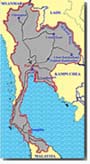
Thailand (previously known as Siam) has been populated ever since the dawn of civilization in Asia. There are conflicting opinions of the origins of the Thais. It presumed that about 4,500 years. Thais originated in northwestern Szechuan in China and later migrated down to Thailand along the southern part of China. They split into two main groups. One settled down in the North and became the kingdom of "Lanna" and the other one is in further south, which afterward was defeated by the Khmers and became the kingdom of "Sukhothai". 
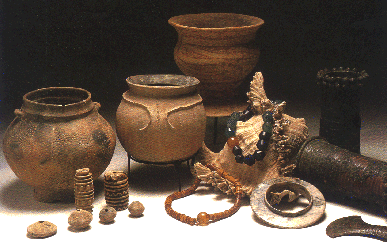
There are conflicting opinions as to the origins of the Thais. Three decades ago it could be said with presumed certainty that the Thais originated in the southern part of what is now China about 4,500 years ago. Recently, however, this theory has been altered by the discovery of prehistoric artifacts in the village of Ban Chiang in the Nong Han District of UdonThani province in the Northeast. From these evidence of bronze metallurgy going back 3,500 years, as well as other indication of a far more sophisticated culture than any previously suspected by archaeologists. It now appears that the Thais might have originated here in Thailand and later scattered to various parts of Asia, including China. 
The controversy over the origin of the Thais shows no sign of definite conclusion as many more theories have been put forward and some even go further to say that Thais were originally of Austronesian rather than Mongoloid. What the outcomes of the dispute may be, by the 13th century the Thais had already settled down within the southeast  Asia. 
 

Khmer Influence
From the 9th to the 11th century, the central and western area of Thailand was occupied by Mon civilization called Dvaravati. The Mon share the same common lineage as the Khmers and settle in southern Burma latter. The Influence of Dvaravati include Nakhon Pathom, Khu Bua, Phong Tuk , and Lawo (Lopburi). Dvaravati was Indianized culture, Theravada Buddhism was remained the major religion in this area.
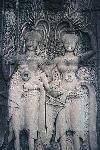
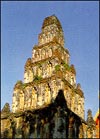
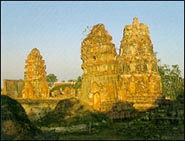
By the 11th-12th centuries, Mon Influenced over central Thailand. Khmer cultural influence was brought in the form of language, art and religion. The "Sanskrit" language was entered in Mon-Thai vocabulary during the Khmer or Lopburi Period. The influence of this period has affected many provinces in the north-east such as Kanchanaburi and Lopburi. The Architecture in "Angkor" was also constructed according to the Khmers style. The Khmer built stone temples in the northeast, some of which have been restored to their former glory, those at Phimai and Phanom Rung and further cultures are stone sculptures and stone Buddha images. Politically, however, the Khmer cultural dominance did not control the whole area but power through vassals and governors. 


Lanna Period
Northern Thailand was once occupied by the ancient Lanna Empire, which spread over Chiang Mai, Lampang, Lamphun and Phayao. Tucked comfortably in a valley, Chiang Mai - Lamphun and Chiang Rai - Phayao represented the two main plateaus of the empire. Known as Haripunchai, Chiang Mai - Lamphun subsequently expanded to include Kelang Nakhon, or Lampang. Meanwhile, Chiang Rai - Payao in those days was known as Yonok. 
The chronicles of the origin of "Lan Na" to "Chiang Saen" lies on the Mae Kong River. Its first leader named "King Mengrai", ascended to the throne in 1259. He extended the kingdom from the borders of Laos to Lamphum. According to an ancient inscription, Haripunchai was seized by Phraya Mengrai, who then built Chiang Mai as hiskingdom's capital. The construction, which started in B.E. 1839 (1296 A.D.) was witnessed by Phya Ngum Muang of Phayao and Phra Ruang of Sukhothai. Apparently, the three kings were close friends and their kingdoms were so closely related that they were like a consolidated nation. Territorial boundaries made no difference to the peoples of the three kingdoms, Who enjoyed an exceptionally active trade relations. As a memorial to such friendly links, a monument of the three kings was built and they now stand immortalized in front of the Chiang Mai City Hall. 
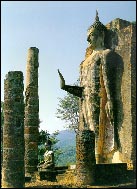
Lan Na flourished for over 200 years. Its arts and literature rose at the peak, especially in the middle of 15th century, the King Tilokoraj period. Chiang Mai in this period was also chosen as the navel of the eight world synod of Theravada Buddhism.

After the death of King Tilokoraj, the kingdom suffered from internal conflicts. Lan Na weakened because of wars with Sukhothai's successors. 
 

Sukhothai Period
Sukhothai, meaning the ''Dawn of Happiness'' was the first truly independent Thai Kingdom founded in 1238, by two Thai chieftains, Khun Bang Klang Tao and Khun Pa Muang , this ending Khmer rule from Angkor Wat. In the early 1300s, Sukhothai enjoyed rule over the Chao Phya River basin, westward to the bay of Bengal and the entire Peninsula. A kingdom that was short-lived but of immense cultural importance in the nation’s history. Sukhothai period was the most flourishing period of Thailand. It quickly expanded its boundary of influence after independence. Sukhothai period was considered to be a golden age of Thai culture. During that time in the history, everybody could say that "There were fish in the waters and rice in the fields". 
 The boundary of Sukhothai stretched from Lampang in the north to Vientiane, in present day Laos and the south to the Malay Peninsula.  Sukhothai saw the Thais’ gradual expansion throughout the entire Chao Phraya River basin and the establishment of  Theravada Buddhism as the paramount Thai religion. During this time Thai had strong friendship with neighboring countries. It absorbed elements of various civilizations which they came into contact. Thai maintained and advanced their culture ties with China. The potters entered Thai artistry and extensive trade was established with Cambodia and India. 
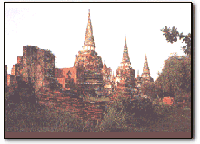
After the death of Khun Pha Muang in 1279, Ramkhamhaeng King, the third son of Si Inthrahit, ascended to the throne. Under the Ramkhamhaeng King, Sukhothai had strong friendship with neighboring China. King Ramkhamhaeng organized a writing system which became the basis for writing and eventually developed to be the modern Thai alphabet. It was here that the first evidence of written Thai was left, along with distinctively Thai styles of art such as painting, sculpture, architecture and literature, which survived after Sukhothai was absorbed by the kingdom of Ayutthaya – a dynamic young kingdom further south in the Chao Phraya River valley.
 

Ayutthaya Period
For 417 years the kingdom of Ayutthaya was the dominant power in the fertile Menam or Chao Phraya Basin. Its capital was Ayutthaya, an island-city situated at the confluence of three rivers, the Chao Phraya, the Pasak, and the Lopburi, which grew into one of Asia's most renowned metropolises, inviting comparison with great European cities such as Paris. The city must indeed have looked majestic, filled as it was with hundreds of monasteries and crisscrossed with several canals and waterways which served as roads. Ayutthaya, the capital of the Thai Kingdom was found by U-Thong King in 1350. Ayutthaya as an island is formed by the gathering of three rivers, the Chao Phraya, the Pasak, and the Lopburi and surrounded by rice terraces. It is easy to see why the Ayutthaya area was settled prior to this date since the site offered a variety of geographical and economic advantages.  Not only is Ayutthaya at the confluence of three rivers, plus some canals, but its proximity to the sea also gave its inhabitants an irresistible stimulus to engage in maritime trade. The rice fields in the immediate environs flooded each year during the rainy season, rendering the city virtually impregnable for several months annually. These fields, of course, had an even more vital function, that of feeding a relatively large population in the Ayutthaya region. Rice grown in these plants yielded a surplus large enough to be exported regularly to various countries in Asia.
The Thai kings of Ayutthaya became powerful in the 14th and 15th centuries, taking over U-Thong, Lopburi, and Ayutthaya. Ayutthaya's first king, Ramathibodi I, was both a warrior and a lawmaker. Some old laws codified in 1805 by the first Bangkok king date from this much earlier reign. King Ramathibodi I and his immediate successors expanded Ayutthaya's territory, especially northward towards Sukhothai and eastward towards the Khmer capital of Angkor. By the 15th century, Ayutthaya had established a firm hegemony over most of the northern and central Thai states, though attempts to conquer Lanna failed. Ayutthaya also captured Angkor on at least one occasion but was unable to hold on to it for long. The Ayutthaya kingdom thus changed, during the 15th century, from being a small state primus inter pares among similar states in central Thailand into an increasingly centralized kingdom wielding tight control over a core area of territory, as well as having looser authority over a string of tributary states.
King U-Thong and his immediate successors expanded Ayutthaya's territory, especially northward towards Sukhothai and eastward towards the Khmer capital of Angkor. The greater size of Ayutthaya's territory, as compared with that of Sukhothai, meant that the method of government could not remain the same as during the days of King Ramkhamhaeng. The paternalistic and benevolent Buddhist kingship of Sukhothai would not have worked in Ayutthaya. The king of the latter therefore created a complex administrative system allied to a hierarchical social system. This administ rative system dating from the reign of King Trailok, or Borommatrailokanat(1448-1488), was to evolve into the modern Thai bureaucracy. The Ayutthaya bureaucracy contained a hierarchy of ranked and titled officials, all of whom had varying amounts of "honor marks" (sakdina). Thai society during the Ayutthaya period also became strictly hierarchical. There were, roughly, three classes of people, with the king at the very apex of the structure. At the bottom of the social scale, and the most numerous, were the commoners (freemen or phrai) and the slaves. Above the commoners were the officials or "nobles" (khunnang), while at the top of the scale were the princes (chao). The one classless sector of Thai society was the Buddhist monkhood, or sangha, into which all classes of Thai men could be ordained. The monkhood was the institution which could weld together all the different social classes, the Buddhist monasteries being the center of all Thai communities both urban and a gricultural.
The Ayutthaya kings were not only Buddhist kings who ruled according to the dhamma (dharma), but they were also devaraja, god-kings whose sacred power was associated with the Hindu, gods Indra and Vishnu. To many Western observers, the kings of Ayutthaya were treated as if they were gods. The French Abbe de Choisy, who came to Ayutthaya in 1685, wrote that, "the king has absolute power. He is truly the god of the Siamese: no-one dares to utter his name." Another 17th century writer, the Dutchman Van Vliet, remarked that the king of Siam was "honoured and worshipped by his subjects more than a god.
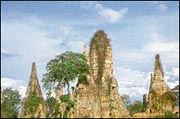
The Ayutthaya period was early Thai history's great era of international trade. Ayutthaya's role as a port made it one of Southeast Asia's richest emporia. The port of Ayutthaya was an entrepot, an international market place where goods from the Far East could be bought or bartered in exchange for merchandise from the Malay/Indonesian Archipelago, India, or Persia, not to mention local wares or produce from Ayutthaya's vast hinterland. The trading world of the Indian Ocean was accessible to Ayutthaya through its possession, for much of its 417-year history, of the seaport of Mergui on the Bay of Bengal. This port in Tenasserim province was linked to the capital by a wild but ancient and frequently used overland trade route.

Throughout its long history, Ayutthaya had a thriving commerce in "forest produce", principally sapanwood (a wood which produces reddish dye), eaglewood (an aromatic wood), benzoin (a type of incense), gumlac (used as wax), and deerhides (much in d emand in Japan). Elephant teeth and rhinoceros horns were also highly valued exports, but the former was a strict royal monopoly and the latter relatively rare, especially compared with deerhides. Ayutthaya also sold provisions such as rice and dried fish to other Southeast Asian states. The range of minerals found in the kingdom was limit ed, but tin from Phuket ("Junkceylon") and Nakhon Si Thammarat ("Ligor") was much sought after by both Asian and European traders.
The Chinese, with their large and versatile junks, were the traders who had the most regular and sustained contact with Ayutthaya. The Ayutthaya kings, in order to conduct a steady and profitable trade with Ming and Manchu China, from the 14th to t he 18th centuries, entered willingly into a tributary relationship with the Chinese emperors. The Thais recognized Chinese suzerainty and China's preeminent position in Asia in return for Chinese political sanction and, even more desirable, Chinese luxury goods. Muslim merchants came from India and further West to sell their highly-prized clothes both to Thais and to other foreign traders. So dominant were Chinese and Muslim merchants in Ayutthaya that an old Thai law dating back to the 15th century divides the Thai king's foreign trade department into two: a Chinese section and a Muslim section. Chinese, Indians, and later on Japanese and Persians all settled in Ayutthaya, the Thai kings welcoming their presence and granting them complete freedom of worship. Several of these foreigners became important cour t officials.
Containing merchandise from all corners of Asia, the thriving markets of Ayutthaya attracted traders from Europe. The Portuguese were the first to arrive, in 1511, at the time when Albuquerque was attempting to conquer Melaka (Malacca). They conclu ded their first treaty with Ayutthaya in 1516, receiving permission to settle in Ayutthaya and other Thai ports in return for supplying guns and ammunition to the Thai king. Portugal's powerful neighbor Spain was the next European nation to arrive in Ayutthaya, towards the end of the 16th century. The early 17th century saw the arrival of two northern European East India Companies: The Du tch (V.O.C) and the British. The Dutch East India Company played a vital role in Ayutthaya's foreign trade from 1605 until 1765, succeeding in obtaining from the Thai kings a deerhide export monopoly as well as one of all the tin sold at Nakhon Si Thammarat. The Dutch sold Thai sapanwood and deerhides for good profits in Japan during Japan's exclusion period, after 1635.
The French first arrived in 1662, during the reign of Ayutthaya's most outward-looking and cosmopolitan ruler, King Narai (1656-1688). French missionaries and merchants came to the capital, and during the 1680's splendid embassies were exchanged between King Narai and King Louis XIV. The French tried to convert King Narai to Christianity and also attempted to gain a foothold in the Thai kingdom when, in 1687, they sent troops to garrison Bangkok and Mergui. When a succession conflict broke out in 1688 an anti-French official seized power, drove out the French garrisons, and executed King Narai's Greek favorite Constantine Phaulkon, who had bee championing the French cause. After 1688, Ayutthaya had less cont act with Western nations, but there was no policy of national exclusion. Indeed, there was increased trading contact with China after 1683,and there was continued trade with the Dutch, the Indians, and various neighbouring countries.
Ayutthaya's relations with its neighbours were not always cordial. Wars were fought against Cambodia, Lanna, Lanchang (Laos), Pattani, and above all, Burma, Ayutthaya's powerful neighbour to the west. Burmese power waxed an d waned in cycles according to their administrative efficiency in the control of manpower. Whenever Burma was in an expansionist phase, Ayutthaya suffered. In 1569, King Bayinnaung captured Ayutthaya, thus initiating over a decade's subjection to the Burmese. One of the greatest Thai military leaders, Prince (later King) Naresuan, then emerged to declare Ayutthaya's independence and to defeat the Burmese in several battles and skirmishes, culminating in the victory of Nong Sarai, when he killed the Burmese Crown Prince in combat on elephant back.
During the 18th century Burma again adopted an expansionist policy. The kings of the Alaunghphaya Dynasty were intent on subduing the Ayutthaya kingdom, then in cultural and artistic prime. The Burmese invaded Ayutthaya  in 1765. This time Burmese caused much fear to Thais. Burmese soldiers destroyed everything, including temples, manuscripts, and religious sculpture. After the capital fell in their hands for two years, the Burmese effectiveness could not further hold the kingdom. Phaya Taksin, a Thai general, promoted himself to be the king in 1769. He ruled the new capital of Thonburi on the bank of Chao Phraya River, opposite Bangkok. Thais regained control of their country and thus scattered themselves to the provinces in the north and central part of Thailand. Taksin eventually turn himself to be the next Buddha and was dismissed and executed by his ministers who did not approve his religious values. 
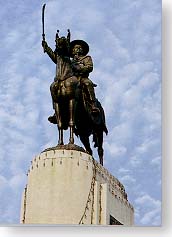


Thonburi Period
Thonburi was founded by a Thai general named Phraya Taksin, who was later crowned King Taksin Maharaj. After the fall of Ayutthaya to the Burmese in 1767, Thonburi, situated on the west bank of the Chao Phraya opposite what is now the City of Bangkok, became the new Thai capital.
After the shattering defeat which had culminated in Ayutthaya's destruction, the death and capture of thousands of Thais by the victorious Burmese, and the dispersal of several potential Thai leaders, the situation seemed hopeless. It was a time of darkness and of troubles for the Thai nation. Members of the old royal family of Ayutthaya had died, escaped, or been captured by the Burmese and many rival claimants for the throne emerged, based in different areas of the country. But out of this national catastrophe emerged yet another saviour of the Thai state -  the half-Chinese general Phraya Taksin, former governor of Tak. Within a few years this determined warrior had defeated not only all his rivals but also the Burmese invaders and had set himself up as king,
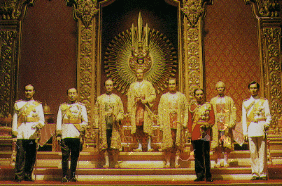
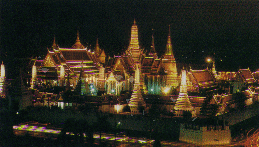
Since Ayutthaya had been so completely devastated. King Taksin chose to establish his capital at ThonBuri [ across the river from Bangkok ]. Although a small town, ThonBuri was strategically situated near the mouth of the Chao Phraya River and therefore suitable as a seaport. The Thais needed weapons, and one way of acquiring them was through trade. Besides, foreign trade was also needed to bolster the Thai economy, which had suffered extensively during the war with Burma (now Myanmar). Chinese and Chinese-Thai traders helped revive the economy by engaging in maritime trade with neighboring states, with China, and with some European nations.

King Taksin's prowess as a general and as an inspirational leader meant that all attempts by the Burmese to re-conquer Siam failed. The rallying of the Thai nation during a time of crisis was King Taksin's greatest achievement. However, he was also interested in cultural revival, in literature and the arts. He was deeply religious and studied meditation to an advanced level. The stress and strain of such much fighting and the responsibility of rebuilding a centralized Thai state took their toll on the king. Following an internal political conflict in 1782. King Taksin's fellow general Chao Phraya Chakri was chosen king. King Taksin's achievements have caused to bestow on him the epithet "The Great".


Rattanakosin Period
The Chakris were inaugurated on April 6, 1782 together with the coronation of Rama I or King Buddha Yot Fa Chulalok. He moved the capital across the Chao Phaya River from Thonburi to a small village known as "Bangkok" and raised up new laws to rule the country. Under his reign, Thailand covered all areas of present day Laos and parts of Burma, Cambodia and Kedah province in Malaysia.

In 1809, Rama II or King Buddha Loet Lad, son of Rama I took the throne until 1824. He devoted himself to preserve the Thai literature that had remained from Ayutthaya period and produced a new version of Ramakien or Thai Ramayana, the classical literature.

In 1824-1851, Rama III or King Nang Klao was successful in re-establishing relation and making trades with China which was necessary to meet the increasing domestic agricultural production.

Rama IV or King Mongkut (Phra Chom Klao), who reigned from 1851 to 1868 lived as a Buddhist monk for 27 years. During his monastic period, he could speak many languages such as Latin, English, and five other languages. He also studied western sciences and adopted the discipline of local Mon monk. Under his reign, he created new laws to improve the women's and children's right, opened new waterways and roads, and created the first printing press.

Rama V or King Chulalongkorn, Rama IV's son, continued the throne from 1868 to 1910. He started to reform the tradition, legal and administrative realm by allowing officials to sit on chairs during royal audiences. Under the reign of Rama V, Thailand developed relations with European nations and the USA. He introduced schools, roads, railways, and Thailand's first post office. He even established civil service system. In 1892, Rama V overhauled the administration of Siam to a form of cabinet government with 12 ministers.

In 1886, Siam lost some territory to French, Laos and British Burma accorded the foreign powers intercede. After that King Chulalongkorn declared Thailand as an independent kingdom on the 23rd of October, making this day as a national holiday. Every year this national holiday is celebrated in commemoration of this event and people lay wreaths in memory of king they called "Phra Piya Maharaj"

Rama VI or King Vajiravudh, took the throne from 1910 to 1925. During his short reign, he introduced the westernization to Thailand. He introduced the primary school education, Thai women were encouraged to grow their hair at a certain length. Surnames were introduced, and football was introduced in Thailand.

1925-1935 was the period of Rama VII or King Prachadhipok, Rama VI's brother. He changed Siam's form of government from absolute monarchy to democracy. This revolution developed the constitutional monarchy along British lines, with mixed military and civilian group in power. At that time, Phibul Songkhram was a key military leader in the 1932 coup. He maintained his position and power from 1938 until the end of World War II.

Rama VIII or King Ananda Mahidol, a nephew of Rama VII, took the throne in 1935 but was assassinated under mysterious circumstances in 1946. His brother King Bhumipol Aduldej succeeded as Rama IX.

Under Rama IX's government, the country's name was officially changed from "Siam" to "Thailand" in 1946 which was defined in Thai as "Prathet Thai", the word "Prathet" means "country" and the word "Thai" means "free" referring to the Thai races.             
  
[Top of Page]     

Send mail to webmaster@HelloSiam.com with questions or comments about this web site.
Copyright © 2000 - 2002 HelloSiam.com   All rights reserved.


KETURUNAN SIAM MALAYSIA.

Walaupun saya sebagai rakyat malaysia yang berketurunan siam malaysia,saya tetap bangga saya adalah thai malaysia.Pada setiap tahun saya akan sambut perayaan di thailand iaitu hari kebesaraan raja thai serta saya memasang bendera kebangsaan gajah putih.

LinkWithin